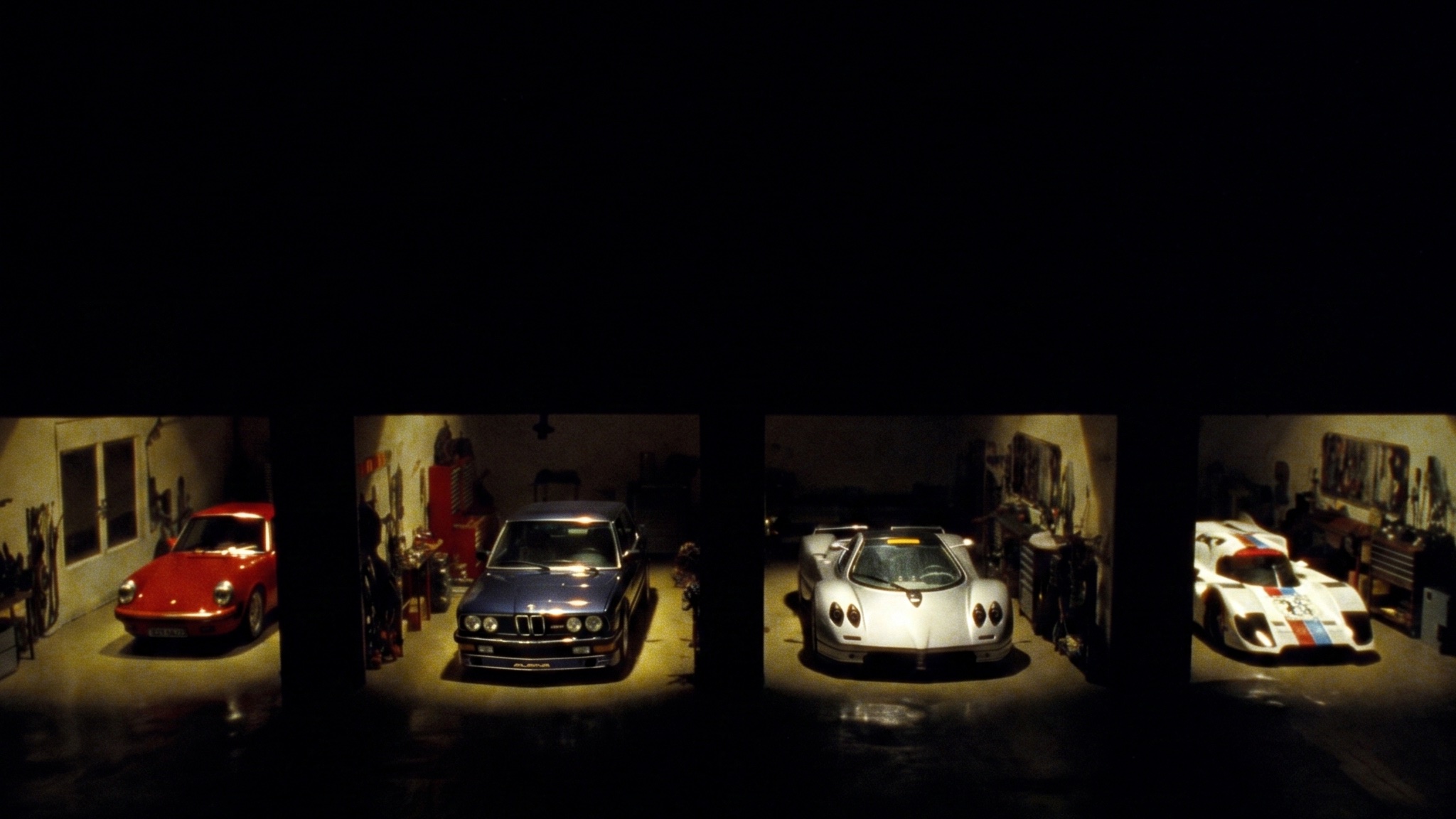
The Garage · 001
How the greats
actually arrived
Four founders. Four machines. One pattern. Step inside.
Every ambitious builder falls into the same trap sooner or later. It sounds like this: “ahh yes, THIS is the thing.” The idea locks before the object exists. The brand gets named before anything pulls. This piece is the antidote I wrote for myself. It follows four men who built the most revered car marques on earth, and in every case the path was sideways, slow, and started with an object. None of them began with the brand. The brand arrived last.
Chapter 0
The four, at a glance
| Founder | Origin | The artifact | Age at brand | Spark → brand |
|---|---|---|---|---|
| Rob Dickinson | Norfolk, UK → LA | His own 1969 911. Strangers kept trying to buy it | ~44 | ~7 years |
| Burkard Bovensiepen | Bavaria, Germany | A carburettor kit for his own disappointing BMW | ~28 | ~3 years |
| Horacio Pagani | Casilda, rural Argentina | A bank-loan autoclave his employer refused to buy | ~43 | ~16 years |
| Jimmy Price | Port Elizabeth, South Africa | A kit-car factory, then sanctions. He waited | ~48 | ~10+ years |
Median time from first spark to brand: about a decade. Median age at founding: early-to-mid forties. Hold those two numbers. Everything else hangs off them.
Chapter 01 · Los Angeles · est. 2009
Singer
The rock star who couldn't stop polishing one car.
The south of France, early 1970s. A father lifts his five-year-old son toward a parked Porsche 911, and something in the boy refuses to let go. Rob Dickinson spent the next forty years circling back to that car, mostly without knowing it.
The obvious route came first. He studied automotive design at Coventry and drew cars for Lotus in the late eighties. Then he did the thing no career counsellor signs off: he quit to front a rock band. Catherine Wheel took the whole of the 1990s. Albums, American tours, festival stages. From the outside it looked like a detour from cars. It was the apprenticeship. Ten years of learning taste, performance, and what makes a crowd lean in, three minutes at a time.


The band ended in 2000. He landed in Los Angeles in 2003 to make a solo record. Late thirties, between careers, renting in the Hollywood Hills. This is the part of the story nobody frames on a wall: by any sensible measure, he was adrift.
The car arrived before the plan did. In 2002 he restored a Bahama Yellow 1969 911E and kept going long past restoration. A 3.0 litre engine where the original sat. Recaro buckets. The stance and lightness of the racing 911s he had loved as a boy, assembled the way a café racer gets assembled. He called it the Brown Bomber and drove it every day. Then strangers started stopping him. At petrol stations. Outside coffee shops. On Sunset. Not to compliment the car. To buy it.
Strangers kept asking to buy his car. That, and not a business plan, was the founding event.
The trigger · Hollywood Hills · 2002–2008

The part nobody frames on the wall
He rented workshop space near Los Angeles in late 2008 and took a commission. The first car went to Monterey in 2010 and the room went quiet in the right way. The books told another story. He charged one early customer $300,000 and spent $800,000 building the car. His own admission: he picked the number out of thin air. For years the company lost money on nearly every build, and he thought seriously about closing it.
What survived was a sentence he spray-painted on the workshop wall back when Singer was a few men in a rented corner: “Everything is Important.” It started as a reminder. It became the entire company.
The quiet genius
One more move deserves study, and it is the restrained one. Singer never sells you a car. It restores the 964 you already own, and the finished thing is called “a Porsche 911 reimagined by Singer.” Porsche's trademark stays untouched. The lawyers stay home. Even the name is a double courtesy: it honours the great Porsche engineer Norbert Singer, and the founder's first life as a singer.
- ✗Quit a working music career at 37 to hand-build one car with no plan.
- ✗Price the first commissions by feel and eat a half-million-dollar loss learning the true cost.
- ✗Obsess over details no customer asked for, until the obsession itself became the product.
Chapter 02 · Buchloe, Bavaria · est. 1965
Alpina
The typewriter heir whose garage product BMW itself co-signed.
Buchloe, Bavaria, the early 1960s. In an outbuilding of his father's typewriter factory, a man in his mid-twenties is quietly furious at his own car. The new BMW 1500, the celebrated Neue Klasse, the machine that saved BMW, is slower than it should be. Burkard Bovensiepen does not write a complaint letter. He builds the fix.
The fix was a pair of Weber carburettors on a kit an owner could bolt to his own engine. What happened next almost never happens in this industry. BMW tested the kit, and instead of sending lawyers, the company's own sales chief certified that cars running Bovensiepen's parts kept their factory warranty. A garage product, underwritten by the factory itself. Alpina Burkard Bovensiepen KG followed in 1965, borrowing its name from the typewriter business next door.

He couldn't afford a motor show stand. So he walked the car park and tucked a brochure under the wiper of every BMW 1500 he could find. It sold the first hundred kits.
The move no planner makes · Frankfurt · 1965
The next two decades were spent earning the right to be taken seriously. Touring car victories through the seventies. The CSL years. Then complete cars, and in 1983 the German Federal Ministry of Transport recognised Alpina as an automobile manufacturer in its own right. Its own chassis numbers. Legally a carmaker, no longer a tuner. Alpina cars came to be assembled on BMW's own production lines: a B7 travels down the same Dingolfing line as the 7 Series it grew from, its hand-built engine shipped in from Buchloe.


Choosing what not to fight
Bovensiepen's sharpest discipline was restraint. Alpina never went head to head with BMW's own M division. It sold speed with comfort and left the track wars alone. And from 1979 he ran a second business importing fine wine. An odd detail, until you see what it is: a second engine, uncorrelated with the first.
The family sold the Alpina name to BMW in 2022. Not in distress, at full strength, after fifty-seven years of independence, and they kept the wine business. Bovensiepen died the following year at 87. Every rival that chose the other path is gone: Hartge closed in 2019, AC Schnitzer announced its end in 2026. The entire species of independent BMW tuner is now extinct, except the one that stopped being a tuner in 1983.
- ✗Launch a car company from a typewriter factory's outbuilding because your own car annoyed you.
- ✗Skip the trade-show stand and leaflet the car park by hand.
- ✗Refuse to fight the M division head-on, for six straight decades.
Chapter 03 · Casilda → Modena · Zonda 1999
Pagani
The Argentine who bought the oven his boss refused to.
Casilda, rural Argentina, the 1960s. A baker's son shapes little cars out of balsa wood and reads everything he can find about Leonardo da Vinci, from whom he takes an idea he still repeats today: art and science can walk together. There is no road from Casilda to Modena. He decides to walk it anyway.
By his early twenties he had designed and built a single-seater racer with his own hands. It caught the eye of Oreste Berta, Argentina's great racing engineer, who took the young man to meet Juan Manuel Fangio. The five-time world champion listened, believed, and wrote five letters of introduction to the sports car houses of Italy. Pagani arrived in Modena around 1983 with his wife, almost no money, and the letters. Lamborghini took him on at the third level, near the floor he was sweeping.


He rose into composites work, running development on the Countach Evoluzione, and became certain that carbon fibre was the future of the fast car. So he asked Lamborghini's management to buy an autoclave, the pressurised oven that cures it. The refusal became industry legend: Ferrari doesn't have one, why should we? Pagani went to a bank, signed a personal loan, and in 1987 bought the oven himself.
The structure the whole story turns on
In 1991 he left and founded Modena Design, a consultancy building carbon composites for Formula 1 teams, for Daimler, for Aprilia. Excellent, profitable, unglamorous work. For most of a decade the consultancy paid for everything: the facility, the team, and the slow development of the car he had been sketching since the late eighties. The boring business funded the dream car. No investor to please. No clock running against him.
When the car needed an engine worthy of it, Fangio helped one last time and opened the door to Mercedes, whose AMG division agreed to supply its V12. The Zonda C12 reached the Geneva stand in 1999, named for a wind that comes off the Andes, sixteen years after its maker stepped off the boat. He was 43.
- ✗Take a personal bank loan for industrial equipment your employer explicitly rejected.
- ✗Spend a decade building other people's parts brilliantly so your own car could exist debt-free.
- ✗Emigrate across the world on the strength of five letters and a handshake.
Chapter 04 · Hi-Tech Automotive / Superformance · South Africa
Gqeberha
The proof already parked in the Eastern Cape.
Port Elizabeth, early 1980s. Jimmy Price meets Richard De Beer, who runs a small factory building MG TD kit cars, and invests with a simple plan: build them properly, sell them to the world. Then the world closes. United States sanctions against apartheid South Africa shut the export door completely.
A spreadsheet says walk away. Price kept the factory alive on local orders and waited out a political era. When the door reopened in the nineties, Hi-Tech Automotive was ready in a way no startup could have been. By the end of 1995 it had built 75 cars, with Superformance established in the United States as the distribution arm.
Becoming the estate's factory
Then came the move that separates this story from every other replica shop on earth. The most protective, most litigious brand estate in classic motoring belongs to Carroll Shelby, and Price did not dodge it. He courted it, met its standard, and became its factory. Hi-Tech's Cobras, Daytona Coupes and GT40s carry official Shelby chassis numbers under licence, and the factory builds cars for Shelby's own Heritage Collection.

The architecture is the lesson for anyone building from the bottom of Africa. Craft lives at home: around 300 skilled people in Gqeberha, roughly 2,000 hours of hand work in a single Cobra, some 6,000 cars over three decades. Commerce lives in the customer's market: an American company that sells the car, wears the local face, and answers the phone in the customer's time zone.
- ✗Keep building world-market cars in a country the world market had legally shut out.
- ✗Court the most protective licensing estate in the industry instead of dodging it.
The synthesis
Seven patterns that actually repeat
Nobody started with the brand. Everybody started with an object.
A car. A carburettor kit. An autoclave. A factory. The vision was retrofitted onto a thing that already worked and already pulled people in. Starting at the brand end is the trap. These four started at the object end and let demand name the company.
The validation was external pull, every single time.
Strangers on Sunset Boulevard. BMW's own sales chief. Fangio's five letters. Shelby's chassis numbers. None of them argued their way in. They built something whose quality made someone powerful volunteer. The test of the artifact: does it recruit without being asked?
The apprenticeship was long, and looked like a detour.
Ten years in a rock band. A composites shop in Sant'Agata. A typewriter factory. Kit cars through sanctions. Median spark-to-brand: about a decade. The detour was the training. Taste, craft, network, and in Pagani's case the funding engine itself.
The dream was funded by a boring adjacent engine, or it nearly died.
Modena Design funded the Zonda. The family factory funded the carburettor kits. Kit cars funded the Cobras. The one founder without an engine, Dickinson, charged $300K, spent $800K, and nearly closed. The engine is not the obstacle to the dream. It is the instrument.
With the giant, never against it.
“Reimagined by Singer” on the customer's own donor car. Manufacturer status inside BMW's world. Shelby's own licence. The control group, Hartge and AC Schnitzer and every tuner who stood outside the walls, is extinct. A marque the incumbent wants to exist is a different species from one it tolerates.
Obsession priced wrong is fatal. Obsession funded properly is the moat.
“Everything is Important” only works with patient capital or an engine behind it. Quality-first is the strategy. Someone still has to pay for the learning curve.
Age is the least interesting variable. Sequence is everything.
44, 28, 43, 48 at brand-founding. What they shared wasn't youth. It was a completed apprenticeship plus an artifact in hand. The order never varies: object, pull, engine, brand.
Why this study exists
A note from the garage
I'm going to build a car marque one day. Something classy, high-end, for the world, in the spirit of what Singer did for the 911. This study is me doing what the four men above all did first: learning the sequence before touching the brand.
Step one is already in my garage. An NC Mazda MX-5, waiting on a Honda K24 heart. The object comes first. The rest, as the pattern says, will name itself.
The Garage · a series
001 · You are here
How the greats actually arrived
Four founders, four machines, one pattern. The study you just read.
002 · In the workshop
The build log
An NC roadster, a Honda K24 heart, and step one of the pattern practised in my own garage. Coming when the wrench turns.